Headliner Publications Promo
This slot is closing.
- Ends in 24 hours. No extensions.
Offer expires in:
Days
Hours
Minutes
Seconds
Once it’s gone, it’s gone.
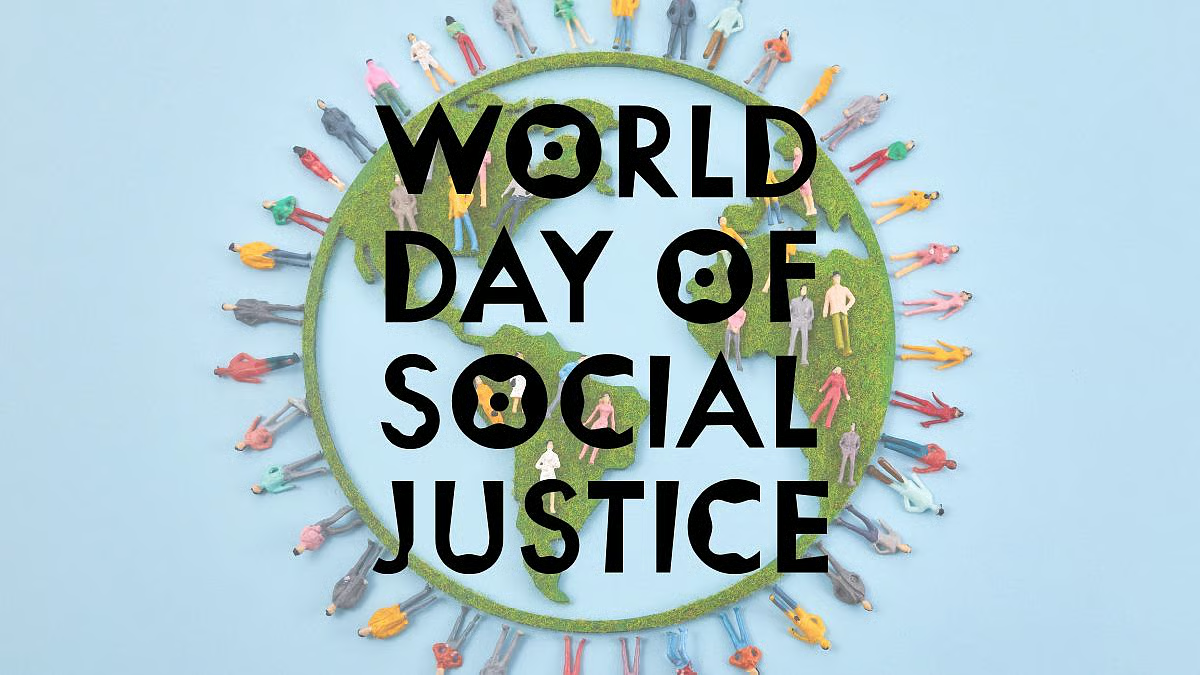
World Day of Social Justice is not just a symbolic date. It is a reminder that narratives shape behaviour, policy, reputation, and public trust. In a world where information spreads fast and context is often missing, the way an organisation communicates about justice-related issues can either build understanding or cause harm. That is why PR matters here, not as publicity, but as responsibility. PR determines which facts are highlighted, which voices are centered, what tone is used, and whether the story respects the dignity of the people involved.
The common failure on social justice observances is performative messaging. Organizations post generic statements about “standing for justice” without explaining what they actually do, what outcomes they are driving, or what accountability exists. Audiences are increasingly tired of this. Editors are cautious about publishing it. Stakeholders question it. The result is that many messages either get ignored or attract criticism. Responsible PR solves this by shifting from virtue signaling to measurable storytelling.
Responsible narratives begin with clarity, not emotion. Emotion can be present, but clarity must lead. If you are communicating about a social justice initiative, your message must explain what the initiative is, why it exists, who it serves, what actions are being taken, and what results are expected. A responsible narrative also includes boundaries. It avoids blaming language. It avoids inflammatory framing that escalates tensions. It avoids oversimplifying complex issues into slogans. This is how you prevent misinformation and protect communities from being turned into content.
Ethical storytelling is central to social justice communication. Many campaigns unintentionally exploit the people they claim to support. They show vulnerable images without consent. They reduce communities to stereotypes. They portray suffering as a marketing asset. That approach can harm people, trigger backlash, and destroy trust. Ethical PR protects dignity by centering consent, context, and respect. It focuses on systems and solutions, not just trauma. It highlights people’s agency, not only their hardship. It uses careful language that does not strip people of humanity.
A responsible narrative also requires evidence. Social justice stories are sensitive, and credibility matters. If you claim impact, you must support it. That support can be program data, timelines, partnerships, third-party involvement, transparent reporting, or clearly described monitoring and evaluation practices. Evidence does not need to be complicated, but it must be real. Even simple metrics help, like number of beneficiaries served, locations covered, programs delivered, or measurable improvements observed. When evidence is present, editors feel safer publishing because the story is anchored in fact.
This is where press releases become powerful, especially when distributed properly. A press release forces structure. It requires you to answer key questions clearly and in order. It reduces ambiguity. It also creates a public record that can be referenced later. A social justice press release should not read like an advertisement. It should read like a factual update. The headline should state the action, not the virtue. The opening paragraph should explain what is being launched or reported and why it matters now. The body should provide context, actions taken, evidence, and next steps. The quote should add accountability and learning, not celebration.
Quotes are especially important on social justice narratives because they reveal intention. A weak quote sounds like “we are proud to support.” A stronger quote sounds like leadership responsibility, explaining why the issue matters, what the organisation is doing, how impact will be measured, and what long-term commitment looks like. Responsible quotes also avoid attacking others. They focus on what you are building, improving, and learning, because social justice narratives should reduce harm, not create new divisions.
Distribution matters because social justice messages can easily be taken out of context when confined to social media. Screenshots remove nuance. Comments distort meaning. A press release distributed through credible pathways helps preserve context because the message appears in a structured form that can be read fully and referenced. Pressdia supports this by providing a distribution route that moves your official narrative beyond your owned channels and into broader media pipelines. This is important when you want your message to be understood, not simply seen.
However, distribution alone is not enough. Responsible PR includes supporting assets that make verification easy. A short transparency note on your website, a simple program overview, a public FAQ, and a clear contact person for media follow-up all strengthen credibility. When people can verify details quickly, misinformation loses momentum. When journalists can ask questions easily, coverage becomes more accurate. This is how you protect your narrative from being misunderstood.
World Day of Social Justice also offers a strategic opportunity to showcase responsible work without turning it into a campaign of self-praise. The goal is not to look moral. The goal is to communicate responsibly, build trust, and contribute to public understanding. This can apply to NGOs, corporates, founders, institutions, and public-facing leaders. If you are addressing workplace inclusion, show the concrete systems you implemented. If you are addressing community development, show the measurable interventions. If you are addressing education or health inequities, show the program design and outcomes. Specificity beats slogans every time.
Amplification should be aligned, not random. If your narrative strongly involves women’s empowerment, women’s economic participation, or women-led community outcomes, sharing through Talented Women Network can amplify the story within a community already built around these themes. If the narrative includes leadership, governance, and institutional credibility angles, a deeper feature framing through Empire Magazine Africa can strengthen authority and nuance. If the story fits into broader African leadership and impact visibility narratives, Crest Africa can reinforce the legitimacy lens, especially when the work reflects measurable change and not only rhetoric.
Measurement should focus on trust outcomes, not applause. Track quality of coverage, stakeholder response, partnership interest, volunteer signups, donor confidence, employee sentiment, and public perception changes. Track whether the narrative reduced confusion or increased understanding. Responsible PR is successful when it creates clarity, protects dignity, and strengthens credibility. If your message creates backlash because it sounds performative or unclear, that is feedback that the narrative design needs work.World Day of Social Justice is a reminder that communication is power. PR is how that power is shaped. When done responsibly, PR can help society understand complex issues better, can spotlight solutions without exploiting pain, and can build trust in institutions that do real work. When done carelessly, PR can harm communities and destroy credibility. Pressdia can be part of the responsible approach by enabling structured distribution, but the real standard is the narrative itself: truthful, measured, respectful, and anchored in action.